Tuesday, 19 October 2010
Berman Guedes Stretton Architects Prize 2010 / For creative originality in Design / Anna Bear 2nd Year
Berman Guedes Stretton Architects Prize 2010
For creative originality in Design
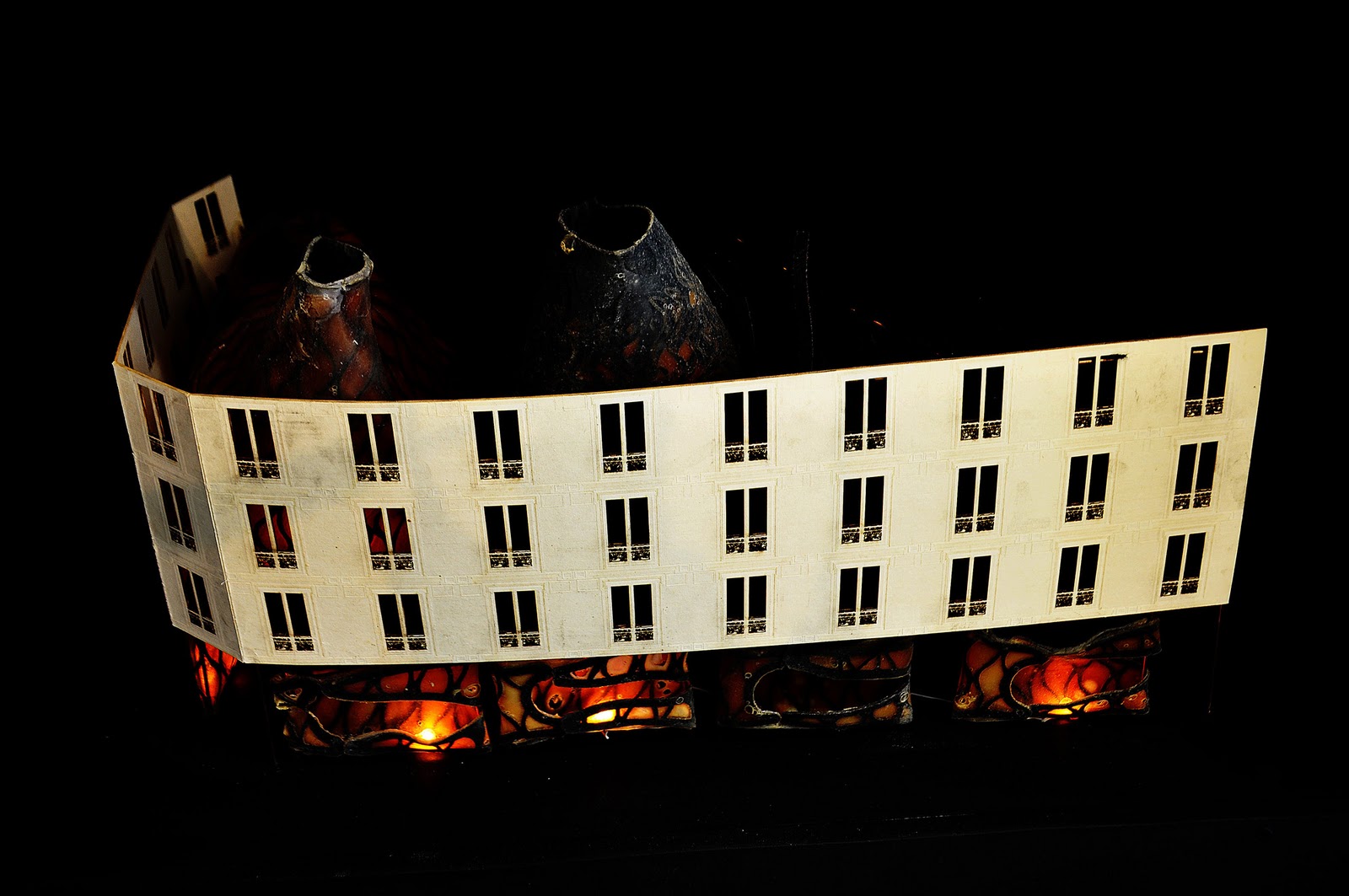
Anna Beer (Unit E, Oxford Brookes University), Pinnacle moment– Celebration of garden
The water garden attempts to experiment a spatial boundary between land and water. The organic symmetrical form commemorates the 8m water rise in the 1910 Paris floods. A meteorological research laboratory not only celebrates Paris’ rich academic history, but also regulates and displays the weather conditions, and warns of severe climatic changes.
Unit E in BLUEPRINT
Edmund's project from Unit E was choosen as one of the best student projects in Britain by Blueprint magazine.
'An inhabitable bridge for performing arts. Seeking to blur the boundary between artist and voyeur anyone using the bridge was to become a part of its exhibition, the performance itself. Taking its cue from a brief of semi-living architecture the bridge became a series of separate organisms each in constant flux between introversion and extroversion imitating the life of plants, slowly gathering energy so as to present themselves to the world. ‘Organism’ has become one of the architectural trends recently. Among those looking at similar approach to organism, this semi-living architecture proposal suggests a new definition of ‘organic architecture. Mami Sayo'
Link: Blueprint
Flexible Fragility / Cultural Arts Centre / Diana Ester Elia / 3rd year
The proposal responds to the brief and the site as a symbiotic fusion between architecture, landscape and infrastructure. The concept is that of structure which springs from the preserved facade, enhancing the connection of the past to the future, and envelops a cultural centre with a flexible performance hall, a cafe, and a viewing pod which rises from the complex allowing the visitors to enjoy in the inspirational views of the art district of Montmartre. The intent is a building ecology, where there is a strong correlation between the object and the environment with a reference to the metabolic structures of plants and humans. It is a translation of the fragility found in a delicate leaf and the study of the metabolic reactions such as the use of daylight and wind . The building then becomes a semi- living structure which, in the same way as the leaf, is shaped by the context and the environmental factors of daylight and wind.
Unit E Architecture Design studio / Summer Exhibition 2010
Unit E Architecture Design studio
Kenny Kinugasa-Tsui / Justin C.K Lau
Summer Exhibition
Summer Exhibition
Luxurious, Luxuriance, and Loss
3rd year students / Andrey Mitov, Diana Elia, George Guest, James Simcock, John Barham, Kate Jones, Michael Bell, Michelle Evans, Mital Patel, Pavel Stankov, Rachel Shotliff, Simon Kent, Saeid, Thomas Pniewski, Viral Shah
2nd year students / Abigail Reid, Abigail Whitelow, Anna Beer, Ayiannis Christo, Bharat Pankhania, Edmund Drury, Ergit Bedalli, James Booth, Jonathan Gillett, Joshua Evans, Kah Shuen Lee, Sebastian Andraos
The Agave, often called the Century Plant, can live up to 60 years, but it only blossoms once in its lifetime. When it blooms, it is unexpected, and takes less than 4 weeks for the ornamental plant to grow a thick stem that enable spiraling branches and beautiful fl owers to reach for the sky, up to 12-15 metres. The main plant then dies after its once-in-a-life-time moment. Nonetheless, the after life of the plant provides a wide range of useful resources for human beings. For hundreds of years, humans have used various parts of the Century Plant to produce rope, clothing, pins, needles, food, tequila, and many more. Hence, the blossoming period is a spectacle would attract unprecedented attentions and public interests on an architectural scale, generating a small temporary economy. (e.g. local news, school and children visits, talks, research, education activities, exhibitions, tourist attractions, production of consumer goods, etc) The long and short-term narratives of the Century Plant will be used to initiate a wide range of design themes. Throughout the year, students will be asked to respond to the unit’s agenda, by investigating the spatial enquiries of ‘luxurious, luxuriant, and loss’, and incorporate such qualities into their designs.
Saturday, 25 September 2010
Unit E 2010-11 (First day)
The first unit activity is on Thursday 30th October at the Strollers Cafe of Stoneleigh Park, Warwickshire, 10.30am. (You must fill in an emergency’s contact form for the office and bring one copy with you for the tutors).
The digital experimentation of unit E focuses on a digital design methodology that is driven by the spatial, poetic and scientific investigations of botany; an ‘organic’ computational design process that is constantly fluctuating to engage with human input of personalities and designer’s emotions. The desire to flourish, manifest, festive, tribute, honour, and celebrate; creates a fertile condition for lifting spirits and constructing optimism in architecture.

Subscribe to:
Posts (Atom)